

How Agentic Compilation Works?

In our previous article, we introduced Agentic Compilation—an architecture that changes how AI-powered browser automation works.
Instead of asking an AI model what to do before every browser action, Selfotix uses AI to understand your goal, generate a complete browser workflow, and let the browser execute it.
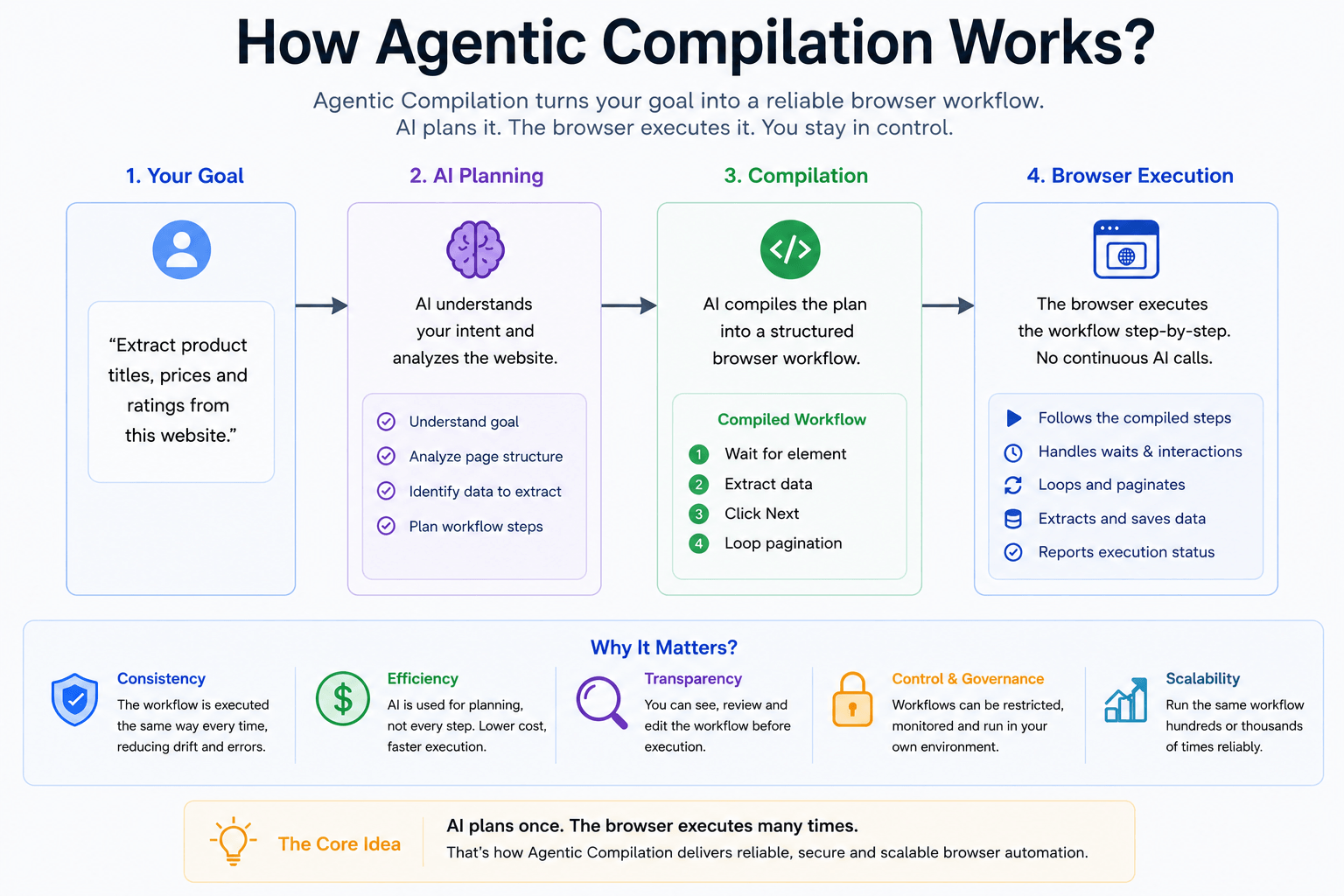
When you click Generate Workflow, a lot happens behind the scenes in just a few seconds.
Let’s walk through the process.
Step 1: Your Goal
Everything starts with a simple prompt.
For example:
“Extract product titles, prices, and ratings from this website.”
You don’t need to inspect HTML, write CSS selectors, or manually build a workflow.
Instead, Selfotix first focuses on understanding what you’re trying to accomplish.
At this stage, AI works to:
- Understand your goal
- Interpret your instructions
- Determine what data should be collected
- Identify the browser actions required to complete the task
Nothing is executed yet.
The objective is to fully understand your request before automation begins.
Step 2: AI Planning
Once your goal is understood, Selfotix analyzes the website.
AI studies the page to understand its structure and determine how the workflow should be built.
This includes identifying:
- Search fields
- Buttons
- Links
- Lists
- Pagination
- Data elements
- CSS selectors needed for interaction
During this stage, AI is essentially planning the automation.
It determines:
- Which browser actions are required
- Which elements should be interacted with
- What information needs to be extracted
- How the workflow should progress from start to finish
Think of this as creating the strategy before doing any work.
Step 3: Agentic Compilation
This is where Agentic Compilation takes place.
Instead of generating one browser action at a time, Selfotix compiles your request into a structured browser workflow.
That workflow becomes an executable blueprint containing everything needed to complete the task.
Depending on the automation, the compiled workflow may include:
- Wait for page elements
- Browser navigation
- Clicking buttons
- Entering text
- Extracting structured data
- Pagination
- Loops
- Waiting for dynamic content
Think of it like creating a construction blueprint before building a house.
Once the blueprint is complete, it can be executed repeatedly without asking AI to rethink every step.
Step 4: Browser Execution
After compilation, the browser becomes the execution engine.
Instead of repeatedly calling an AI model for instructions, the browser simply follows the compiled workflow.
It can:
- Follow the compiled workflow step by step
- Wait for elements to appear
- Handle page interactions
- Navigate through pagination
- Repeat loops automatically
- Extract structured data
- Report workflow execution status
This separation between planning and execution is the foundation of Agentic Compilation.
AI plans.
The browser executes.
Why This Architecture Matters
Separating AI planning from browser execution provides several practical benefits.
Consistency
Every execution follows the same compiled workflow, reducing unnecessary variation and workflow drift.
Efficiency
AI is used for planning—not every browser action—making execution faster and reducing unnecessary AI usage.
Transparency
Generated workflows remain visible, allowing users to inspect, review, and improve them before execution.
Control & Governance
Users stay in control of the workflow. They can modify browser steps, update selectors, and understand exactly how the automation works.
Scalability
Whether the workflow runs once or thousands of times, the browser follows the same execution plan consistently.
From Goal to Browser Automation
Agentic Compilation changes the role of AI.
AI is no longer responsible for making every browser decision.
Instead, AI understands your goal, plans the workflow, and compiles it into an executable blueprint.
From that point onward, the browser performs what it does best—executing repetitive work accurately and consistently.
That’s the core idea behind Agentic Compilation.
AI plans once. The browser executes many times.