

How Does Agentic Compilation Impact AI Governance and Security?

In our previous articles, we introduced Agentic Compilation and explained how it changes the way AI-powered browser automation works.
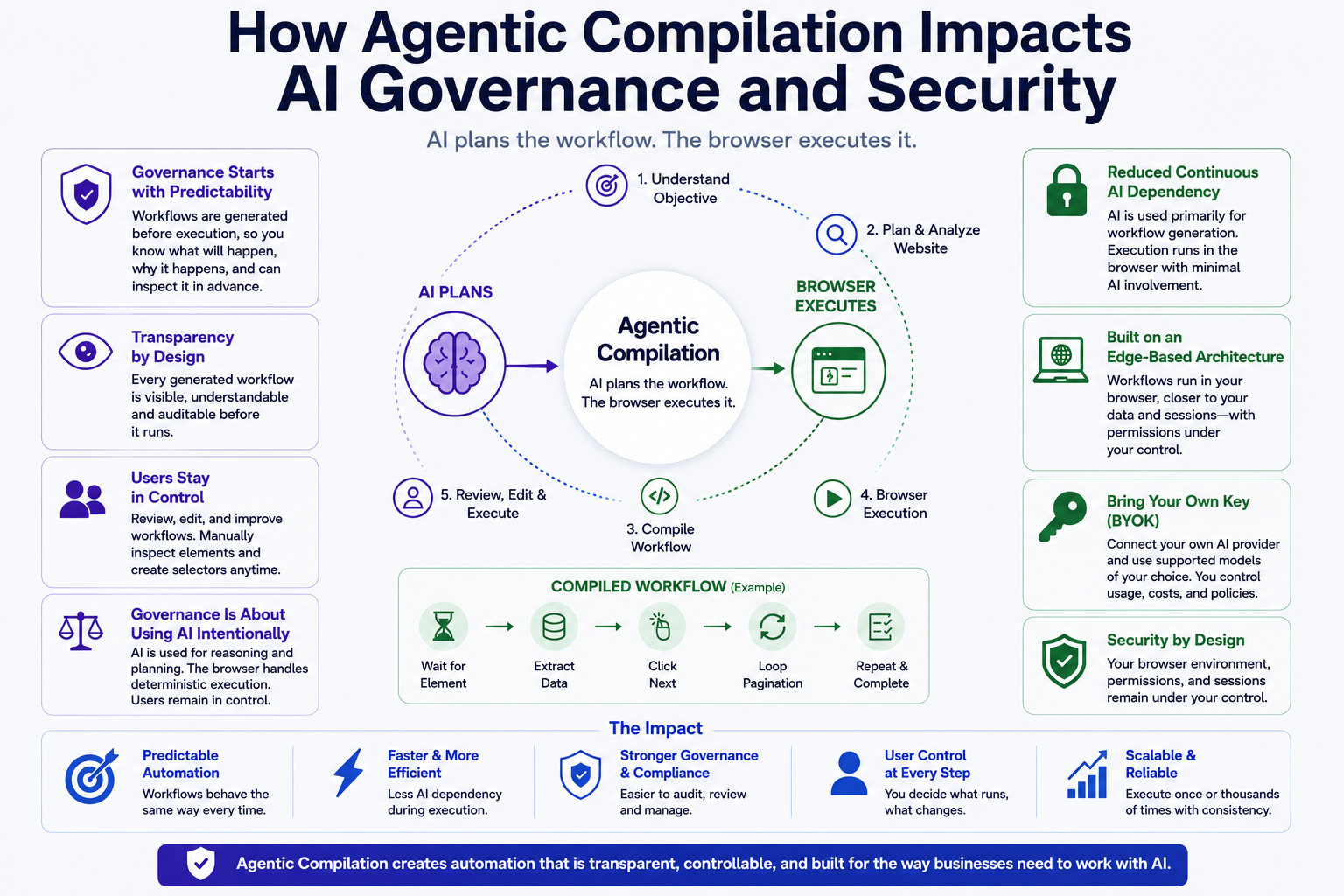
Instead of asking an AI model what to do before every browser action, Selfotix uses AI to understand your objective, generate a browser workflow, and let the browser execute it.
Selfotix architecture isn’t just about improving performance or reducing AI usage.
It also has important implications for AI governance, security, and user control.
As more organizations adopt AI, one question becomes increasingly important:
How do you automate work without giving AI unnecessary control over every step?
That’s one of the problems Agentic Compilation was designed to address.
Governance Starts with Predictability
When businesses automate critical workflows, they need more than automation.
They need confidence.
They need to know:
- What will the workflow do?
- Why is it performing a particular action?
- Can someone inspect it before it runs?
- Can it be modified if business requirements change?
If the answer to every browser action depends on a live AI decision, those questions become harder to answer.
With Agentic Compilation, the workflow is created before execution begins.
Instead of continuously asking an AI model what to do next, the browser follows a compiled workflow.
Because the workflow already exists, users can inspect it, understand it, and modify it before execution.
That makes automation more transparent and easier to govern.
AI Should Plan. Software Should Execute.
One of the design principles behind Selfotix is simple.
AI is excellent at planning.
Software is excellent at execution.
Large language models are incredibly good at understanding intent, reasoning through problems, and generating workflows.
Browsers are incredibly good at repeating actions consistently.
Instead of asking AI to make thousands of decisions during execution, Agentic Compilation separates these responsibilities.
AI plans.
The browser executes.
That separation makes workflows easier to understand and easier to trust.
Reducing Unnecessary AI Exposure
Every time an AI model is called, information must be shared with that model.
Depending on the workflow, this could include:
- Browser context
- Page structure
- User instructions
- Website content
The more often AI is involved during execution, the more frequently that context needs to be processed.
Agentic Compilation reduces this dependency by limiting AI to the workflow generation phase.
Once the workflow has been compiled, browser execution no longer depends on continuous AI reasoning.
This creates a simpler and more predictable execution model.
Users Stay in Control
Automation should never become a black box.
That’s why Selfotix doesn’t hide the workflow from the user.
Generated workflows remain visible.
They can be reviewed.
They can be edited.
They can be improved.
Experienced users can even manually inspect web elements and create selectors themselves whenever they want.
AI accelerates workflow creation.
It doesn’t remove user control.
We believe this balance is essential for professional browser automation.
Built for an Edge-First Architecture
Selfotix is designed around an edge-first architecture.
Instead of executing workflows inside a remote cloud browser, workflows run inside your own browser.
This provides several practical benefits.
- You remain closer to your own data and browser session.
- Automation happens where the work already exists.
- Browser permissions remain under your control.
- There’s less reliance on a centralized execution environment.
For many organizations, this architecture aligns better with privacy and governance requirements than cloud-only automation.
Why BYOK Matters
Selfotix also follows a Bring Your Own Key (BYOK) model.
Rather than forcing every customer through a shared AI infrastructure, you connect your own AI provider.
This gives you control over:
- Which AI model you use
- Your own AI usage and costs
- When to upgrade to newer models
- Your organization’s AI policies
As AI models evolve, you’re not locked into a single provider or waiting for platform-wide updates.
Your AI stack evolves with your business.
Governance Isn’t About Using More AI
One of the biggest misconceptions in AI automation is that more AI automatically creates better automation.
We don’t believe that’s true.
Good governance comes from using AI deliberately.
Use AI where reasoning is needed.
Use software where consistency is needed.
Keep workflows visible.
Keep users in control.
Build systems that people can understand.
That’s the principle behind Agentic Compilation.
Building AI Automation Businesses Can Trust
As AI becomes part of everyday business operations, governance and security will become just as important as model performance.
Organizations won’t simply ask:
“Can AI automate this?”
They’ll ask:
“Can we trust it?”
“Can we understand it?”
“Can we control it?”
Agentic Compilation was designed with those questions in mind.
By separating AI planning from browser execution, Selfotix creates workflows that are easier to inspect, easier to govern, and easier to trust.
We believe the future of AI automation isn’t about giving AI more control.
It’s about giving users more confidence in how AI is used.
That’s the next step in building AI automation that’s ready for real-world business use.